
Heartbreak in Vancouver: Canada’s Historic Run Takes an Unexpected Turn
The atmosphere at B.C. The place was electric. Thousands of Canadian supporters, led by five flag-draped Vancouver police horses, had marched to the stadium, chanting and singing their way down the “last mile” walk. Inside the venue, fans held aloft No. 8 posters to honor injured midfielder Ismaël Koné, who had suffered a broken leg in the previous match against Qatar. This was a moment Canada had waited generations for.
And in many ways, history was already made. Canada had secured its first-ever World Cup point and followed it up with a spectacular 6-0 dismantling of Qatar—the nation’s first men’s World Cup victory. The team had already guaranteed qualification for the knockout stage for the first time in its history.
But the stakes on this sweltering June afternoon in Vancouver were higher still. A win or even a draw against Switzerland would see Canada finish top of Group B, securing a week’s rest, a Round of 32 match in Vancouver, and the potential of a Round of 16 home game as well. The dream of a deep home-soil run was tantalizingly close.
How Switzerland Spoiled the Party
A Costly Defensive Lapse
The first half was tense and physical, steeped in the sort of anxiety that accompanies the most important game of a team’s life. Switzerland, ranked 17th in the world, compared to Canada’s 29th, dominated possession and created the first real danger when Breel Embolo was set free on a breakaway in the 11th minute. Canadian keeper Maxime Crépeau came out and made himself big for a brave, stunning save.
With an injury-depleted starting lineup—stand-in captain Stephen Eustáquio was left out due to muscle tightness, and Ismaël Koné was out with a broken leg—Canada’s makeshift midfield of Nathan Saliba and Mathieu Choinière grew into their surprise roles. The Canadians even earned some reasonable attempts as the game settled into a chippy, sweat-soaked duel. But no goals were scored in the first half, notable only for two yellow cards handed out to Swiss captain Granit Xhaka and Canada striker Cyle Larin after the pair clashed over a quick free kick.
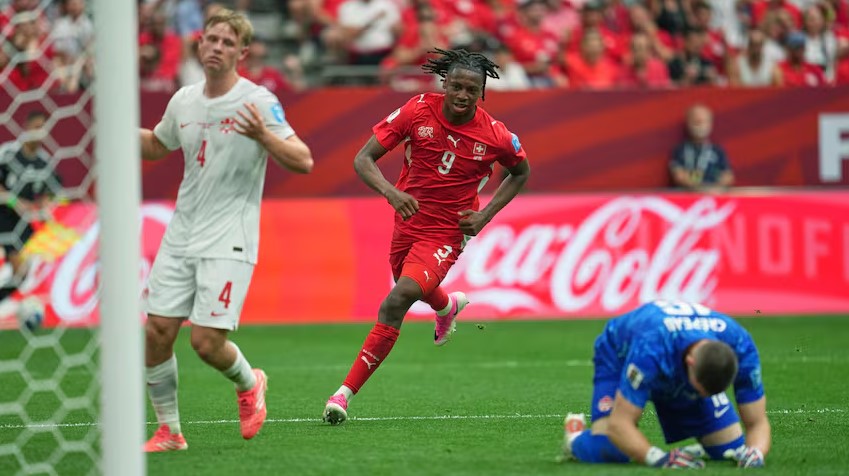
Then came the fate-turning moment. Early in the second half, Canada’s otherwise impressive backline was pulled too far to the left during a relatively innocuous Swiss attack. The shift left Rubén Vargas—among Switzerland’s most lethal finishers—wide open in the box. When the ball came across to him, Canada’s wild scramble came too late, and Vargas made no mistake with his chance. That was it. That was all it took for fates and paths to start to change.
Switzerland Strikes Again
The second goal came in the 57th minute, just as Canadian substitutes were waiting to come on. Johan Manzambi, who had already provided the assist for Vargas’s opener, capped off an impressive performance with a goal of his own. Following a well-executed combination in the midfield, the young Swiss player broke free and finished neatly, doubling the lead to 2-0.
Crépeau got a piece of it and would have liked to have done better, but his disappointment felt more global than specific. Canada had needed only a draw to win the group; suddenly, even a draw felt out of reach. The Swiss had turned up the heat, and the home side was struggling to respond.
Promise David’s Spark
With nothing left to lose, head coach Jesse Marsch made several substitutions to bolster the attack. One of them was Promise David, a striker who had made a bold prediction months earlier.
In May, David had told CBC in an interview: “I have this weird thing where I can call out goals before I score them.” He had foretold that he would score in Vancouver.
And he kept his word. Coming on as a substitute, David found the net before the stadium announcer had even finished announcing his arrival in the game. His close-range finish in the 76th minute narrowed the deficit to 2-1 and lit up the capacity crowd.
The remaining time was tense as Canada threw everything they had at trying to equalize. Relentless pressure and an ovation of appreciation for it filled the stadium, but goalkeeper Gregor Kobel and the Swiss defense played with focus, neutralizing a series of dangerous situations. The equalizer never came. Canada’s first defeat of the tournament was also its most painful.
The Road Ahead: LA Bound
What Second Place Means

The result pushed Canada to second place in Group B with four points, behind Switzerland’s seven. While Bosnia-Herzegovina finished third with four points as well, Canada advanced thanks to a superior goal difference.
But the prize of the top spot—and a continuation of the home-soil journey—was gone. Three knockout fixtures had been staged in Canada: last-32 matches in Vancouver and Toronto, plus a last-16 game in Vancouver. Instead of enjoying a week of rest in familiar surroundings with home support, Canada would now travel to Los Angeles for a Sunday matchup on just three days’ rest.
“The feeling inside the locker room is disappointment because we wanted to be here for the next two games,” Crépeau admitted.
Potential Knockout Opponents
Canada’s second-place finish set up a Round of 32 clash against the second-place team from Group A—almost certainly South Korea. The South Koreans had been sitting second in Group A with one loss and one draw, set to take on winless South Africa in their final match.
The path now looked significantly more difficult. A victory in Los Angeles would advance Canada to a Round of 16 game in Houston on July 4, and another win would send the team to a quarterfinal in Boston on July 9. It was a tougher road than the Vancouver route, which would have offered home advantage and potentially easier opponents from third-place groups.
Jesse Marsch’s Challenge
Now, head coach Jesse Marsch, who had been open about his desire to stay in Vancouver, must rally his team for its mission to Los Angeles instead. The former Leeds boss had already guided Canada out of the group stage at a World Cup for the first time, but the disappointment of the loss made the achievement difficult to see in the moment.
“Mixed emotions,” striker Jonathan David told Sports Illustrated. “Obviously, we wanted to stay in Vancouver, so not getting that is a blow for everyone, but we’ll talk about it and get ready for the next one.”
Marsch himself struck a defiant tone: “We wanted to be here in Vancouver, but we still have a massive opportunity ahead of us to find a way to push for the next match and find a way to electrify the nation still, even though it’ll be from Los Angeles.”
The injury situation remained a concern. Stephen Eustáquio, who had come on as a second-half substitute and helped change the momentum, admitted he only had 30 minutes in him. The hope now is that he will be fit to start in four days. Alphonso Davies, the team’s star left back who had been injured since early May, was training with the team but not yet ready to start. Canada’s depth would be tested once again.
A Bigger Picture: Canada’s Soccer Evolution
For all the heartbreak, it’s important to remember just how far this team has come. Before this World Cup, Canada had never earned a point in the tournament. During a glorious two-week run at home, they took four, including a spectacular dismantling of Qatar.
The pre-match marches to the stadium, packed bars, and non-stop conversations about the team have left lasting memories. Cyle Larin’s late equalizer against Bosnia and Herzegovina, Jonathan David’s hat trick against Qatar, the heartbreak of Koné’s broken leg, and the hope of Promise David’s goal against Switzerland—these are big moments at home that have captivated the country.
“These moments were needed and have brought a certain level of awakening,” wrote one observer.
Jesse Marsch, the passionate American coach who took the job in 2024, has been a driving force behind this transformation. “I felt strongly that I could, through my personality and the football I believe in, help the sport continue to evolve in the country into something people really want to be part of,” he said. “We want to turn this into a football nation.”
If Wednesday’s loss felt like a down note—and it really did feel like the end of something—it’s only because Canada is finally playing World Cup games that matter.
Conclusion: The Story Isn’t Over
Dreams might come true at the World Cup, but they can also disappear in short order. And the teams that get to realize theirs are sometimes the quickest to find a new one.
Canada’s journey remains one of the tournament’s biggest stories. A team that had never earned a point in World Cup history has now advanced to the knockout stage on home soil. The disappointment of not staying in Vancouver only speaks to the growth and belief this team has built.
As they head to Los Angeles to face South Korea, Marsch and his men must remember that they have already made history—and they can still make more. It will just be a different story than they had allowed themselves to imagine. The knockout stage awaits. The Canadian dream is not over; it has simply moved to a new stage.