
The Algorithm Assists: How AI and Biometrics Are Transforming the 2026 World Cup
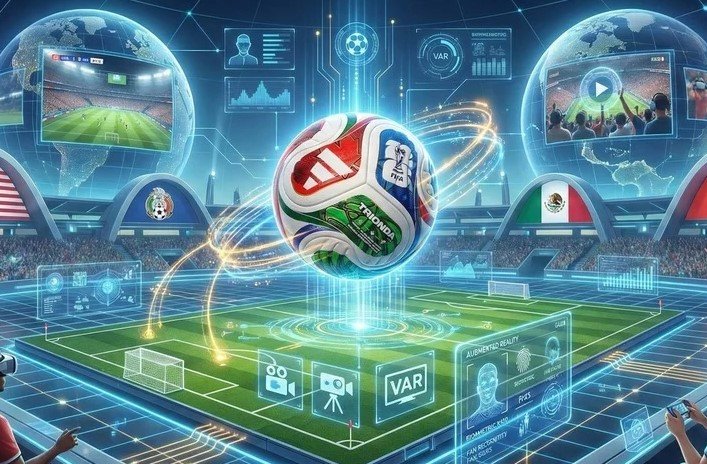
The 2026 World Cup is not just a celebration of football—it’s a showcase of how cutting-edge technology is reshaping the beautiful game. With 48 teams competing across 104 matches in three host nations, the tournament has generated an unprecedented amount of operational data. To manage this complexity, organizers have transformed the world’s biggest sporting event into a comprehensive digital ecosystem.
Artificial intelligence, biometric sensors, and advanced tracking systems are no longer just analyzing the game—they are fundamentally changing how it is played, coached, and officiated. From smart balls that track every touch to AI-powered assistants that democratize tactical analysis, the 2026 World Cup represents a technological turning point in football history.
“The combination of AI and IoT is generating a closed-loop digital sports experience,” note researchers developing AI-IoT-integrated platforms for sports training. “IoT sensors record the motion and physiological data; AI models process the data to detect deviations or dangers; and feedback is sent back in real-time.” This cycle transforms training and officiating into an adaptive, data-driven process.
The AI Tactical Analyst
Tracking 50 Times Per Second
At the heart of the tournament’s technological infrastructure are 16 optical tracking cameras installed in each stadium—an increase of four cameras compared to the 2022 World Cup. These cameras monitor 29 data points on each player’s body at a frequency of 50 times per second. This massive data source generates over 150 million tracking data points per match, enabling FIFA to recreate the entire match in a simulated 3D space.
The data serves multiple purposes. It allows the VAR (Video Assistant Referee) to judge whether a player in an offside position is interfering with play—for example, by blocking the goalkeeper’s view. It also helps match officials determine whether the ball has crossed the touchline in the build-up to a goal. And it provides the foundation for the AI-powered analytical tools available to all teams.
Beyond Human Observation
FIFA, in partnership with Lenovo, has introduced Football AI Pro—a generative AI knowledge assistant that provides all 48 participating teams with equal access to advanced match analysis capabilities. Previously, FIFA provided teams with data in the form of reports that ran to 50 or 60 pages for each match, requiring large teams of analysts to interpret them. Football AI Pro makes it much easier for teams to extract the information they need.
“We believe that this could help not only to speed up this process but also democratize it,” said Johannes Holzmüller, FIFA’s Director of Innovation. “Not every participating team can afford a huge team of match analysts. By providing all teams with the same access to the latest technology, we can democratize the use and benefits of the latest technology.”
This democratization is significant. Whether a team has the financial resources to employ a full analytics department or not, they now have access to sophisticated tactical insights—including information on player movements, tactical behaviors, and individual performance patterns.
Semi-Automatic Offside Detection (SAOT) 2.0
The Smart Ball Revolution

The 2026 World Cup introduces the Adidas Trionda, the tournament’s official match ball, with a groundbreaking feature: a smart chip embedded in its core. The name “Trionda” combines “Tri” (three) and “Onda” (wave), representing the three host nations’ colors: red for Canada, green for Mexico, and blue for the United States.
Inside the ball is an extremely sensitive motion sensor capable of recording and transmitting data about the ball’s position and speed at a frequency of up to 500 times per second. The sensor records 500 data points per second, detecting the lightest touch from a boot or hand and creating a clear digital spike. If broadcast cameras lose sight of a crowd of players, this data identifies who last touched the ball.
The Trionda must be charged before each match, with each charge lasting about six hours. Officials keep a supply of these smart balls fully charged and ready on the sidelines. All information collected by the chip is immediately sent to the VAR room within seconds.
3D Player Reconstruction
The advanced semi-automated offside technology (ASAOT) represents a significant upgrade from the system used in Qatar 2022. At the previous World Cup, SAOT operated using 12 specialized cameras tracking 29 points on players’ bodies, combined with sensors in the ball transmitting signals at 500 times per second. However, it had limitations regarding processing time for 3D graphics—up to 10 minutes—and a delay before the linesman could raise the flag.
For 2026, the improved ASAOT version allows for lightning-fast offside calls. Information from clear offside situations is transmitted directly to the referees’ handheld devices or watches on the field, enabling them to raise the flag immediately instead of waiting for confirmation from the VAR room. The threshold has also been reduced: the new system can alert officials if a player is more than 10cm offside, compared to the previous 50cm threshold.
To further enhance accuracy, every participating player has been 3D-scanned, with their images and digital avatars incorporated into the system. This creates enhanced, clearer offside animations for broadcast, where players “really look like the players,” and it’s immediately obvious which players are involved. The technology also addresses the controversial “line of sight” offside decisions, replicating the perspectives of both goalkeepers to help determine whether a goalkeeper’s view was impacted.
Wearable Biometrics: The Invisible Jersey Technology
Monitoring Health in Real Time
Beyond the visible technology on the pitch, a revolution is happening beneath the players’ jerseys. Wearable biometric sensors are enabling real-time health monitoring, creating a shift from reactive sports medicine toward proactive, personalized care.
Researchers are developing frameworks that integrate AI with Internet of Things (IoT)-enabled wearable sensors, collecting heterogeneous data streams including heart rate variability, triaxial accelerometer readings, gyroscopic angular velocity, magnetometer orientation data, and cutaneous temperature signals. “Smart wearables are any object that incorporates electronic technology worn close to the body,” explain researchers. “Information may be tracked in real-time, so coaches no longer need to depend just on timings and splits but on precise measurements of position, distance, velocity, and acceleration.”
The integration of AI with these wearables has led to a paradigm shift in activity recognition and performance analysis. Machine learning algorithms analyze data from wearable devices to classify activities accurately, estimate injury risk from abnormal motion patterns, and support rehabilitation efforts.
Injury Prediction and Prevention
The proposed framework for an interdisciplinary AI center for longevity and well-being outlines five target application domains for wearable biometrics: real-time health monitoring, injury risk assessment, performance optimization, holistic well-being evaluation, and longevity-oriented health management.
AI models can now distinguish among activities such as walking, running, and cycling using motion data from wearable devices. They can be updated based on observed behavior patterns and provide adaptive feedback and recommendations over time. For athletes, this means personalized recovery protocols and early warning systems for potential injuries.
Research on smart sensors and IoT platforms has achieved accuracy ratios of 90%, efficiency of 90.6%, and prediction ratios of 91% for athlete physical monitoring systems. “Accurately predicting an athlete’s physical state via simulation is a cutting-edge scientific method for increasing the efficiency of physical training,” note researchers.
The CoachXNet platform, an AI-IoT integrated system for personalized sports training, has demonstrated that individualized training recommendations result in 18–23% better outcomes compared to non-individualized approaches. The system achieves 94.1% action recognition accuracy with an average end-to-end latency of just 32 milliseconds—fast enough for real-time feedback during training.
The Purist’s Debate: Is Technology Ruining the Game?
Despite these technological advances, the integration of AI and biometrics into football has not been without controversy. Sports scientist Franco Impellizzeri, editor-in-chief of the journal Science and Medicine in Football, identifies AI integration in decision-making, wearables, and sports analytics as major emerging areas. He notes, however, that “whether the teams will have people on their staff who can actually use this information is another question.”
The debate between purists who argue technology is “programming” the sport and advocates who see it as ensuring fairness continues to rage. The implementation of semi-automated offside technology has already faced early challenges. In the Switzerland vs. Qatar match, a controversial penalty kick decision sparked questions about whether the scorer was offside. FIFA later issued a statement citing “a temporary technical glitch” that prevented the generation of the offside judgment animation.
“The longer the delay in releasing evidence, the more suspicion and conspiracy theories grow,” the BBC reported, noting that the delay itself created a bigger problem. The incident highlighted that even cutting-edge technology has limitations, and transparency in its application remains crucial.
FIFA emphasizes that technology only plays a supporting role; the referee on the field retains the final say. The goal is to strike a balance—enhancing accuracy and fairness while preserving the flow and excitement of the beautiful game. As Holzmüller stated, “This technology must be almost invisible to ensure both accuracy and maintain the exciting pace of the game.”
Conclusion: The Future Is Already Here
The 2026 World Cup represents a paradigm shift in how football is played, officiated, and experienced. From the smart Trionda ball transmitting 500 data points per second to Football AI Pro democratizing tactical analysis for all 48 teams, technology is no longer a peripheral addition—it is woven into the fabric of the tournament.
Wearable biometrics and AI-driven monitoring systems are transforming athlete health management from reactive to proactive. Advanced semi-automated offside technology is making decisions faster and more accurate, while referee body cameras with anti-shake technology are bringing fans closer to the action than ever before.
The challenges—technical glitches, transparency concerns, and the purist debate—are real and will need to be addressed. Yet the trajectory is clear: AI and biometrics are here to stay in elite sport. The 2026 World Cup is not just a tournament; it is a blueprint for the future of football, where technology enhances the human elements of skill, strategy, and passion without replacing them.
As Impellizzeri notes, “AI integration in decision-making, using wearables to collect information from players, and sports analytics are major emerging areas.” The future is already here—it’s just beginning to be implemented on the world’s biggest sporting stage.